Blog / How Natural Food Coloring Works

How Natural Food Coloring Works

Share with your friends. Country Kitchen SweetArt Facebook Share via PInterest Country Kitchen SweetArt Twitter Share Share via email print page
collection results from testing natural food coloring on fondant, royal icing, and buttercream

Introduction: Why Natural Food Coloring Behaves Differently

If you’ve ever switched from traditional food coloring to natural food coloring and thought, why doesn’t this look the same? — you’re not alone.

FD&C food colors are designed to be extremely stable and consistent. Natural food colors are made from naturally derived ingredients such as fruits, vegetables, and spices. Because these ingredients are less processed, they can react differently depending on heat, light, and the medium they’re mixed into.

With increased attention on ingredient choices and recent changes in the food coloring landscape, more bakers are exploring natural alternatives. The tradeoff is that natural colors require a slightly different approach and a bit more patience.

In this blog, we’ll share what we learned by testing ENCO’s natural food colors in real baking scenarios — including how they look when first mixed, how they change over time, and which applications give the best results.

Flavor Considerations with Natural Food Coloring

Because natural food colors are derived from plant-based ingredients, some colors may have a very mild flavor or aroma, especially when used in larger amounts. This is normal and not considered a defect.

In most applications, such as buttercream, royal icing, and baked goods, the flavor is subtle and typically not noticeable once the final product is finished. Using the smallest amount needed to achieve your desired shade helps keep both color and flavor balanced.

If flavor is a primary concern for a specific project, we recommend testing ahead of time, especially for lightly flavored frostings or fillings.

How Natural Food Colors Behave: What to Expect Before You Start

Natural food colors, including ENCO’s, create vibrant, natural-looking shades. The colors are rich and eye-catching, without the neon intensity often associated with synthetic food coloring.

Color development is more gradual than with traditional food coloring. The shade you see immediately after mixing may not be the final result, as many natural colors continue to deepen or balance as they rest.

Results can vary depending on the medium. Buttercream, royal icing, and fondant each interact differently with natural pigments, which can affect both color strength and tone.

How Different Mediums Affect Color

In our experience, fat-based frostings like buttercream tend to show richer, more saturated color, while sugar-based mediums such as royal icing and fondant naturally produce softer, more pastel shades. This isn’t a flaw — it’s simply how natural pigments interact with different recipes as they set and dry.

Because natural food colors are derived from plant-based sources, they’re also more sensitive to heat, light, and time. Subtle changes as a project rests or sits out are normal and expected.

Once you understand what to expect, natural food colors become much easier to work with. With a little planning and patience, ENCO’s natural food colors can produce beautiful, vibrant results across a wide range of baking and decorating projects.

Bake-Stable vs. Non-Bake-Stable Colors

ENCO identifies certain natural food colors as bake-stable, meaning they’re designed to better withstand heat during baking. This can be helpful when choosing colors for cakes and other baked goods.

Bake-stable colors:

  • Red
  • Orange
  • Yellow
  • Pink
  • Purple
  • Brown
  • Black

Not labeled as bake-stable:

  • Green
  • Blue
  • Royal Blue

Bake-stable labeling doesn’t mean a color won’t change at all (natural food colors can still be affected by recipe, light, and time), but it does provide helpful guidance when selecting colors for baked applications.

Testing Natural Food Coloring

To give our customers practical, real-world guidance, we tested ENCO’s natural food colors in several common decorating mediums used in their kitchens. The goal was to observe how the colors behaved over time and in different applications, not to measure exact color strength.

Our Testing Process

We mixed the colors using typical decorating amounts and photographed the results shortly after mixing, then again as the colors rested.

We tested ENCO’s natural food colors in:

  • Country Kitchen SweetArt's buttercream frosting (which is shelf-stable, does not require refrigeration, and has a slightly lower pH to help extend shelf life)
  • Homemade frosting (with no preservatives, which tends to be more neutral in pH)
  • Royal icing
  • Fondant

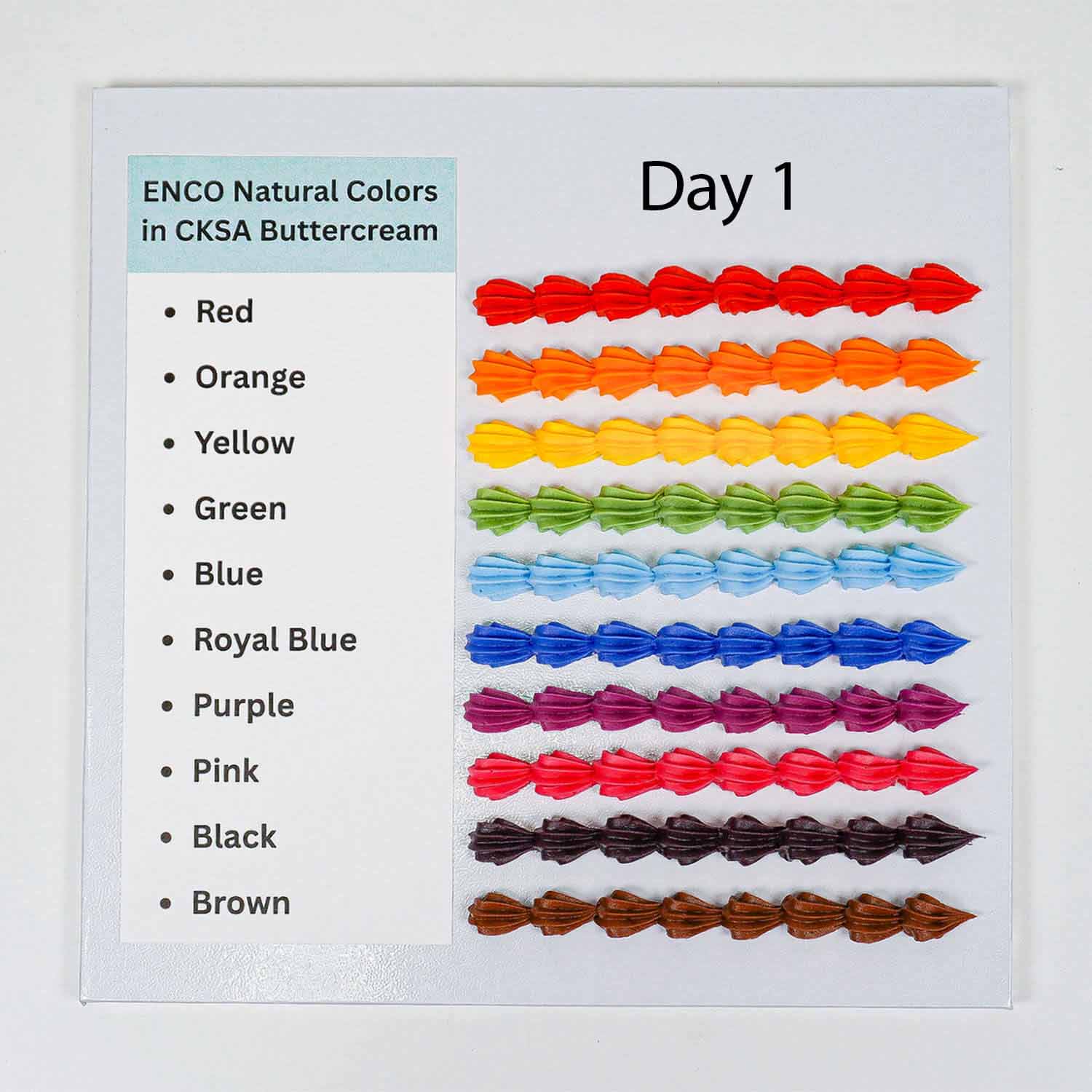
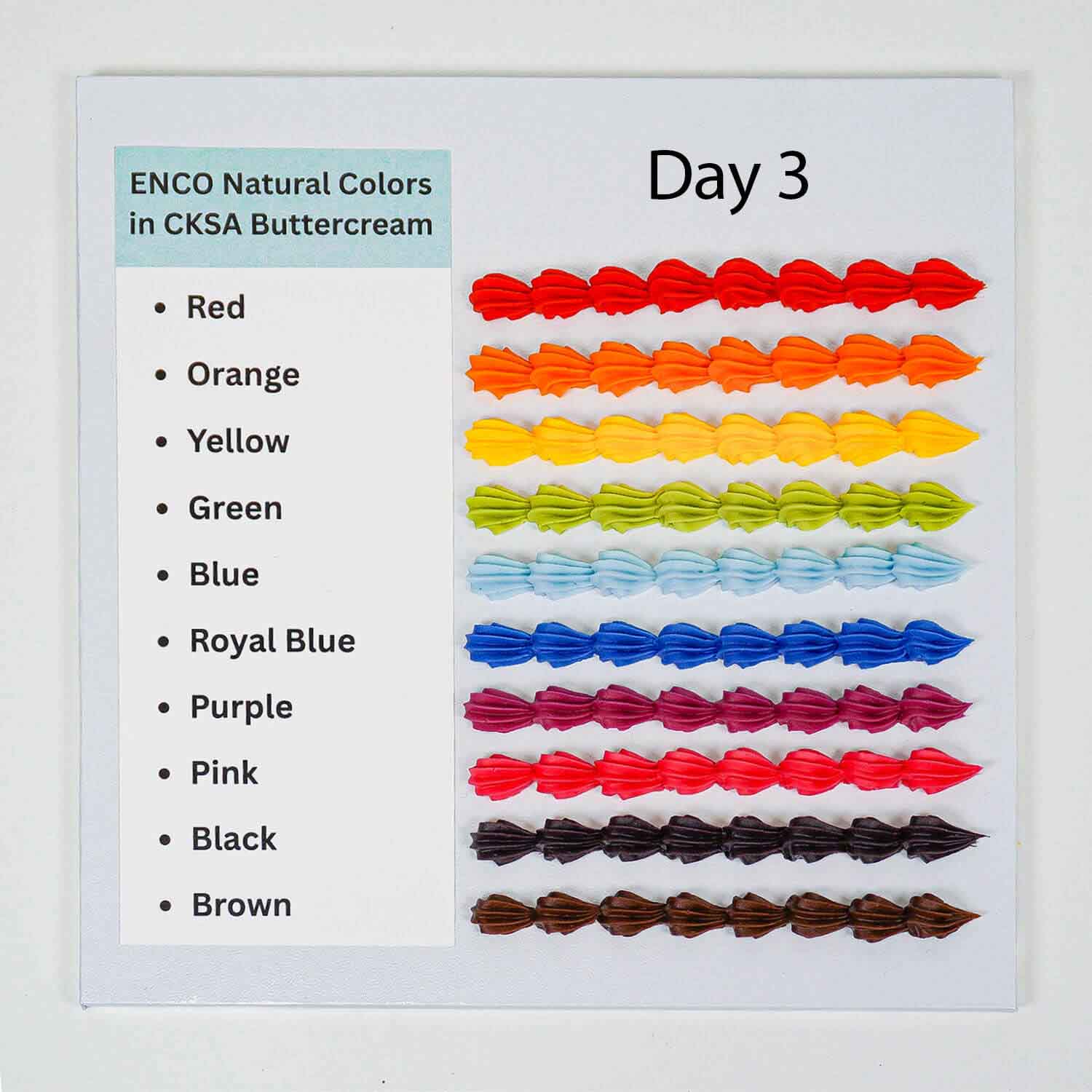
CKSA Buttercream Results

We tested ENCO’s natural food colors in our Country Kitchen SweetArt premade buttercream frosting, which is shelf-stable and formulated with a slightly lower pH to help extend shelf life. A lower pH is common in shelf-stable frostings and is not a negative, but it can influence how natural pigments develop and hold color over time.

Colors that held especially well

Red, yellow, pink, and brown performed very consistently in this buttercream. These colors showed strong vibrancy from the start and remained stable as the frosting rested, with only subtle deepening over time.

Colors with noticeable undertones

Black produced a deep shade with soft purple undertones rather than a flat jet black. Orange leaned warm, with yellow undertones. Purple developed into a rich plum tone instead of a bright violet.

Colors more sensitive in this buttercream

Green shifted toward a bright yellow-green tone with strong yellow undertones. Blue faded significantly and became very pale. Royal blue softened in tone over time. These observations reflect how ENCO’s natural food colors behaved specifically in our CKSA buttercream. Natural pigments can respond differently in other frostings and decorating mediums depending on recipe and pH.

Why Blues and Greens Can Be More Sensitive

Many natural blue and green food colors are commonly derived from ingredients such as spirulina. These naturally derived pigments are known to be more sensitive to acidic environments, which can influence how the color holds over time.

In a lower-pH frosting like our shelf-stable buttercream, this sensitivity helps explain why blue- and green-based shades may fade or shift more noticeably compared to other colors. This behavior is typical of natural pigments and is not unique to one brand or formulation.

Understanding this natural sensitivity makes it easier to plan ahead and choose the best color and base for each project.
test results of using natural food color with fondant

Homemade Buttercream Results

We also tested ENCO’s natural food colors in a homemade buttercream made without preservatives, which typically has a more neutral pH. This allowed us to compare how the colors behaved in a traditional frosting versus our shelf-stable buttercream.

In this buttercream, the colors appeared balanced and consistent. Most shades looked similar immediately after mixing and showed minimal change as the frosting rested, with only subtle color development over time.

Overall, the neutral pH created a stable environment for natural food colors, making this buttercream an easy and forgiving base for decorating.

test results of using natural food color with fondant

Royal Icing Results

We tested ENCO’s natural food colors in royal icing to observe how they behaved in a sugar-based, low-fat medium that dries firm over time.

In royal icing, the colors appeared softer and more pastel compared to buttercream. The shades mixed evenly and looked consistent both immediately after mixing and again after resting overnight, with no noticeable changes observed.

As the icing set and dried, the colors maintained their appearance, making royal icing a predictable and stable medium for natural food coloring. The softer tones are typical for this type of icing and work well for detailed piping, flooding, and cookie decorating.

test results of using natural food color with royal icing

Fondant Results

We also tested ENCO’s natural food colors in fondant to see how they performed in a dense, sugar-based medium.

In fondant, the colors blended smoothly and appeared soft and even. The shades looked consistent right after mixing and remained stable over time, with no significant changes observed after resting.

Similar to royal icing, fondant naturally produces more pastel tones when using natural food colors. The consistent results make fondant a dependable option when a uniform, predictable color is desired.

test results of using natural food color with fondant

What This Means for Your Baking Projects

Natural food coloring behaves a little differently than traditional dyes, but with the right expectations, it can be both beautiful and reliable. Our testing showed that ENCO’s natural food colors perform consistently across a range of decorating mediums and produce vibrant, natural-looking shades that many bakers prefer. We carry the full line of ENCO natural food colors, making it easy to find the right shade for your project and apply what you’ve learned here with confidence.

A Note About Chocolate

ENCO’s natural food colors are water-based, which means they are not compatible with chocolate or other oil-based coatings. Adding water-based color to chocolate can cause it to seize and will not produce usable results.